
Insights

Extend, Rebuild or Replace? A Practical Guide to Legacy System Modernisation in Australia
What to verify before committing to an upgrade, rebuild or replacement.


What to verify before committing to an upgrade, rebuild or replacement.

A practical operating model for founders, CTOs and product leaders balancing reporting commitments, urgent defects and planned product work.

Four validation risks founders, CTOs and product leaders should trace before correcting data or releasing a change.

Four practical controls for truthful completion, safe retry, failure containment and visible recovery during system modernisation.
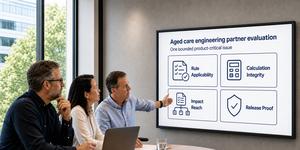
One bounded, product-critical issue can reveal whether a prospective engineering team understands aged care rules, data dependencies, historical impact and release safety. Use this four-gate test before expanding scope.

Two development teams receive the same customer portal request. One estimates the screen. The other examines the workflow, data boundary, access model and what happens after launch. Here is how Australian businesses can tell the difference before committing to a build.

Two aged care software vendors receive the same quality indicator change. One ships a configuration release; the other opens a development project. The four architectural factors that decide which one you are.

How Australian businesses can protect intellectual property, source code and customer data when working with offshore software development partners — IP assignment, synthetic data, APP 8 obligations, and five checks before you sign.

For Australian retail and eCommerce teams: test whether an ERP or development partner understands your pricing, stock, GST and duty—not portfolios—before you sign.

What Australian businesses really pay for offshore software development in 2026 — local cost benchmarks, why rate cards mislead, and how 24-month TCO and developer tenure decide whether the savings stick.

A transparent 2026 ranking of offshore software development companies for Australian businesses, scored on developer tenure, AEST overlap, security certifications, Australian market experience, and AI governance.
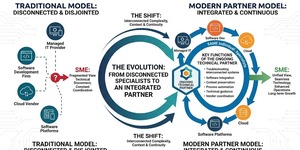
As cloud, SaaS and AI become interconnected, more SMEs are adopting an ongoing technical partner model — not to replace specialists, but to reduce the complexity of coordinating them.


Why most offshore software partnerships stall for Australian SMEs, the four structural factors that predict lasting partnerships, and how to evaluate any provider.

In migration work, confidence should come from honest discovery — not from how clean the proposal looks. Why Early Certainty Feels Reassuring When a potential
Dual-running can sound reassuring in a legacy migration. Both systems stay available.A fallback still exists.Cutover feels less dramatic. But dual-running only reduces risk when the
One of the most common requirements in legacy migration is also one of the most dangerous: “Make the new system work exactly like the old
A migration program can define cutover in great detail and still leave one critical question unanswered: Who owns the new system after go-live? This gap
In complex migrations, a timeline is only as reliable as the risks behind it. One of the most common mistakes in migration planning is treating
A migration plan can look solid on paper. The proposal is structured.The timeline seems reasonable.The team has relevant technical experience. But none of that necessarily
Migration risk goes beyond reading the system In migration projects, the real risk is not whether a partner can read the system. It is whether
It is a question every CTO, VP of Engineering, and technology decision-maker should be asking development partners right now.AI can accelerate software delivery. But not
Imagine an app that does everything, like China’s WeChat and Southeast Asia’s Grab, serve as hubs for a range of services, from messaging and shopping
Modern engineering teams that Integrate AI throughout their software delivery pipeline now reduce cycle times by 40%, shift from weekly to daily releases, and cut